


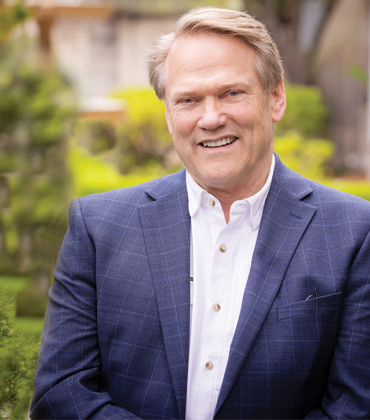
 Gayle D. Beebe, President
That vision has guided the college since Ruth Kerr founded it in 1937 in the hills above Santa Barbara. What began as a bible institute soon grew into a liberal arts college. By the mid-1940s, it had relocated to Montecito and expanded its campus. For nearly nine decades, Westmont has held the conviction that education should not end with the classroom lecture.
Today, the college offers 26 majors across various disciplines, ranging from anthropology and sociology to the natural sciences and engineering. It also provides a distinctive accelerated nursing program in downtown Santa Barbara, blending academic rigor with moral and spiritual formation.
“We want our students to think across disciplines while shaping the outlook needed for a flourishing life,” says Gayle D. Beebe, president. “In classrooms and residence halls, they learn to listen across differences, engage contrary views and find common ground. Amid today’s diverse and often conflicting viewpoints, these habits of citizenship are as vital as any skill.”
Relationships and whole person formation remain central to this approach. Many begin in undergraduate years, but the lessons and experiences last a lifetime. Diversity deepens those connections, with nearly half of the new students from multicultural backgrounds and a growing international student community. Faculty mentors and peers become lasting learning sources, forming a community that reflects a global perspective rooted in Christian faith.
Liberal Arts for Leadership Formation
Turning “thinking across disciplines” into reality happens in unexpected ways at Westmont because tomorrow’s leaders face challenges with no boundaries. Climate change needs scientists who understand policy. Artificial intelligence requires engineers who grasp ethics. Global markets demand executives who can navigate cultural complexity. Yet most colleges still train for narrow specialties.
At Westmont, the intersections are visible every day. A biology major leads chapel worship, connecting molecular complexity with divine design. Business students partner with art majors to launch social enterprises. Engineering students rethink artificial intelligence through required philosophy courses. The curriculum is designed for crossings, not silos.
“When I was studying with Peter Drucker, the father of modern management, he told me, ‘The liberal arts are the best way to prepare to lead, because they teach you how to reach into any area of human knowledge and find solutions.’ That insight captures exactly what we want our students to experience,” says Beebe.
-
We want our students to think across disciplines while shaping the outlook needed for a flourishing life. In classrooms and residence halls, they learn to listen across differences, engage contrary views and find common ground. Amid today’s diverse and often conflicting viewpoints, these habits of citizenship are as vital as any skill. And they are even more necessary in a global space when there are varying cultures, faiths and values trying to approach solutions for real-world issues.
Christian intellectual tradition anchors this integration. For centuries, Christian thinkers have maintained that faith and reason work in tandem to pursue truth. Clement of Alexandria taught that mastering every area of human knowledge prepares the mind for deeper questions about God and reality. Saint Augustine reinforced it. Cardinal Newman continued that vision in the 19th century. Students inherit that legacy. They wrestle with questions of morality in science labs, purpose in business cases and justice in literature seminars. The goal is not knowledge alone but knowledge joined to character.
Formation begins with the classical core of grammar, logic and rhetoric, then builds into arithmetic, geometry, astronomy and music. This frame teaches students how to think before thinking.
Research affirms the value of this approach. Studies from Harvard and Baylor universities show that human flourishing rests less on material success and more on meaning, purpose and relationships. Westmont educates toward that flourishing.
This vision frames education as stewardship. The biblical parable of multiplying gifts offers the model.
“Talent is not a personal asset to hoard. It is a trust to multiply for others,” says Beebe.
That philosophy stretches across campus—biology, sociology, economics and Spanish professors model depth and integrity. Students extend learning through CATLab technology projects, Potter’s Clay community outreach and Urban Initiative justice work. Even residence halls call students to maturity and respect for one another, where character grows alongside knowledge.
Graduates leave with abilities stretched beyond self-interest. Whether they pursue business, science, education, or ministry, they treat gifts and talents as service. Alums remain connected and extend Westmont’s influence across generations and fields, proof that an education grounded in intersections and guided by conviction endures.
Local Presence and Global Reach
Most colleges talk about global citizenship. Westmont builds it. Sixty percent of students study abroad during their undergraduate years—twenty times the national average. These are not semester-long escapes or academic tourism. They are structured experiences integrated into a student’s formation.
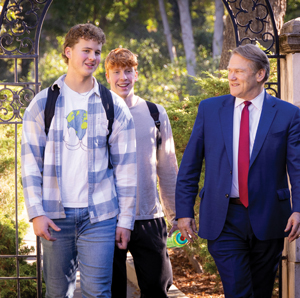 Before departure, students complete an orientation that equips them for cultural, social and ethical complexities. While abroad, faculty mentors accompany them, helping to interpret experiences in real time. On return, a reentry program ensures that learning is integrated, not left as fragments of memory.
“Without proper reintegration, students risk having profound experiences that leave no lasting impact. It can be like a spacecraft burning up on reentry, with all that potential energy lost in the atmosphere,” says Beebe. “The goal is cultivating leaders who can bridge differences with wisdom and humility.”
The campus location amplifies this global frame. Westmont’s Mediterranean setting overlooks the Pacific and is conveniently located within reach of Los Angeles and San Francisco, offering easy access to prominent international hubs. World leaders engage students in dialogue through the Montecito Institute for Executive Education and the annual President’s Breakfast. Guests have included David Brooks, Condoleezza Rice, Henry Kissinger, Doris Kearns Goodwin and Nobel laureates. They participate in sustained exchanges that sharpen their perspective and character.
For students, these encounters connect with their lived experience abroad. Someone who has navigated markets in Morocco or studied conflict resolution in Northern Ireland brings sharper questions to a conversation with a former Secretary of State. Combining immersive study and dialogue with global leaders produces graduates who recognize the complexity of an interconnected world and accept the responsibility to engage with it thoughtfully and responsibly.
Shaping a Flourishing Future
The measure of any institution is found in the lives it shapes. At Westmont, that evidence accumulates year after year in faculty who choose depth over prestige, in alumni whose loyalty creates lifelong networks of mutual support and in graduates whose influence ripples across industries and continents.
Now, external validation is catching up with internal conviction. Westmont collaborates with Harvard and Baylor’s human flourishing research, which explores how people experience meaning, purpose and relationships worldwide. The college finds itself aligned with research that confirms what it has long practiced: education that integrates knowledge, character and purpose produces successful professionals and flourishing human beings.
This validation resonates with Beebe, now in his nineteenth year of leadership. He arrived at Westmont decades ago as a consortium exchange student, discovering what it meant to “learn how to learn” across every discipline. Today, he witnesses that same transformation in students who carry forward the conviction that education is preparation not just for careers but for lives of meaning and service.