


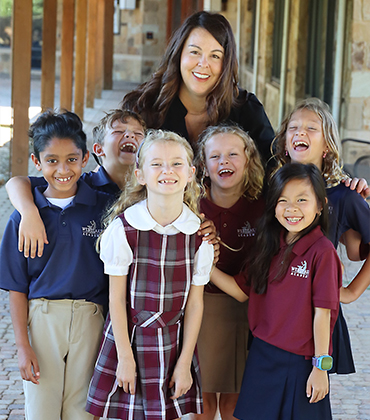
 Dr. Kelly Ritchie, Head of School
What if a public school could be shaped directly by its community, while still offering a globally recognized, world-class education without tuition or compromise?
At Westlake Academy, that question serves as the foundation for a model where community ownership shapes how education is delivered. In this municipally governed public charter school, students progress from kindergarten to graduation within the International Baccalaureate (IB) continuum, which serves as the school’s academic framework, an offering that remains rare in the U.S. The distinction, however, goes beyond access. It reflects how a community has shaped a school that is locally grounded while maintaining a global academic outlook.
These elements position Westlake Academy differently: a tuition-free model, a full K–12 IB continuum, and a governance structure rooted in the community it serves.
That model begins with how the school is governed.
Westlake Academy’s charter is held by the town's residents, represented by its board of trustees. That structure places the school at the center of the community rather than alongside it. Families are not just enrolling their children but choosing to be part of a system that reflects their priorities. For many families, access to the Academy influences where they choose to live. This proximity creates a different kind of accountability. Expectations are immediate, visible, and shared.
Building Ownership through the IB Continuum
How does the IB continuum structure shape long-term student ownership of learning?
At the core of the model is the IB continuum, spanning from kindergarten through grade 12. The structure allows Westlake Academy to build learning as a progression rather than a series of disconnected stages. In the early years, students are introduced to inquiry, encouraged to ask questions, and guided to find their voice in the classroom. As they move through the middle years, that inquiry becomes more structured. By the time they reach the Diploma Program, students are expected to think independently, synthesize information, and take responsibility for their learning.
This progression is not incidental. Student agency is introduced early and reinforced consistently. Younger students learn how to ask for clarification, extend discussions, and engage with ideas beyond surface-level understanding. Older students carry that mindset into more advanced work, where independence is not just encouraged but required.
“We have built a system that teaches students how to take ownership of their learning from the very beginning, and that responsibility grows with them every year,” says Dr. Kelly Ritchie, Head of School.
By the time students reach their final years, ownership is evident in how they approach learning, research, question information, and navigate complexity.
Alignment That Drives Outcomes
Why do alignment and teacher engagement influence consistent academic outcomes across IB programs?
Westlake Academy has maintained a 100 percent graduation rate, alongside a consistently high rate of IB Diploma success over the past five years. These numbers are better understood as outcomes of alignment rather than isolated achievements.
A combination of factors drives this consistency. Teachers form the foundation, supported by highly engaged families who have often chosen the area because of the school, and students who either arrive with a focus on learning or develop it within the environment. At the center of it all are the teachers, who are the primary drivers of these outcomes.
Educators at Westlake Academy are active participants in the IB ecosystem. Many are involved in the IB Educator Network, conducting site visits to other schools and leading workshops within the organization. This engagement creates a feedback loop between global standards and classroom practice. Teachers bring external insights into their instruction while contributing to the broader IB community.
-
We have built a system that teaches students how to take ownership of their learning from the very beginning, and that responsibility grows with them every year.
The effect is cumulative. Students are exposed to a range of perspectives through the curriculum and the people who deliver it. Learning becomes less about coverage and more about engagement with ideas.
Learning Without Borders
In what ways does global exposure enhance student learning beyond classroom instruction environments?
That engagement extends beyond the classroom. Instruction frequently incorporates primary and secondary resources from different parts of the world, often translated into English to ensure accessibility. Students are asked to consider multiple viewpoints, whether they are studying history, literature, or contemporary issues.
Experiential learning reinforces this perspective. Westlake Academy maintains exchange programs with IB schools in Costa Rica and Argentina. Students also participate in international events, including a film competition in Paris, where they interact with peers from across the IB network.
These experiences are integrated into a broader approach that encourages students to think beyond their immediate context.
The impact of this approach becomes most visible outside the classroom. Service learning further anchors this mindset. Students engage in projects that connect classroom learning with real-world impact, prompting them to consider how their actions affect others. The goal is to build awareness while also developing the ability to act on it. The learning model also allows students to explore their interests and shape their learning paths within a structured global framework.
Structure That Allows for Individual Paths
Within this global framework, the school maintains space for individual exploration. The IB model allows for a combination of whole-group instruction, small-group collaboration, and individualized work. Assessments like research papers, investigations, and projects allow students to pursue their interests. This balance enables students to engage deeply while operating within a structured academic system.
At the same time, Westlake Academy operates within clear boundaries. The school is located in a region with a wide range of educational choices, requiring ongoing attention to positioning. That clarity informs decision-making across academics, operations, and growth.
The model is supported through a combination of public funding and a nonprofit foundation that works with parents and donors to enhance resources and sustain program quality, requiring deliberate resource prioritization.
“We are very clear about who we are as an IB World School. That clarity allows us to make decisions that protect the student experience, even in a complex funding environment,” says Dr. Ritchie.
Measuring What Matters
Westlake Academy places equal emphasis on values like compassion, responsibility, and respect. Many participate in volunteer work, fundraising initiatives, and community projects, from maintaining public spaces to supporting disaster relief and awareness campaigns.
This engagement reflects a broader objective to develop individuals who are aware of the world around them and willing to contribute. Academic achievement remains important, but it is not the only measure of success. This approach ensures that students leave equipped with academic knowledge and the ability to think critically, engage with complexity, and navigate a rapidly changing world. Recognition of this approach has followed. Westlake Academy was named Public Charter School of the Year, reflecting the consistency of its model. The award speaks to how governance, curriculum, teaching, and community engagement function together.
Looking ahead, the school continues to invest in its infrastructure. A new building project is underway, with plans to introduce modern science labs and a dedicated visual arts studio. The expansion is scheduled for completion in 2027 and is intended to support the same academic priorities that define the current model.
Westlake Academy is not attempting to reinvent public education. It demonstrates what is possible when a community aligns around a clear vision and sustains it over time. The result is a model that remains grounded in its local context while preparing students to engage with a broader world, combining access and rigor in a model that continues to expand with purpose.