

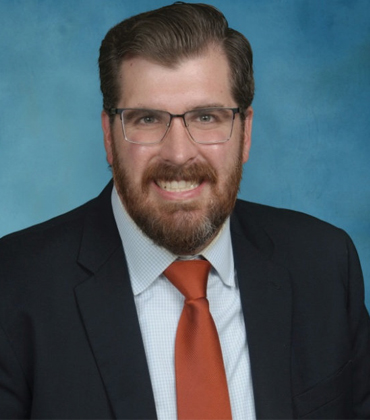
 Michael E. Lawlor, Principal
St. Luke Catholic School operates on a principle many institutions strive to achieve—a community where mission, academics and generational trust grow together.
Rooted in the mission of the Sisters of St. Joseph, the school is committed to developing the whole child, intellectually, spiritually, socially and emotionally. That commitment shapes everything, from rigorous academics and character development to service and faith formation, all oriented around a single daily expectation: that students know, love and serve God.
Six core values—reverence, compassion, forgiveness, inclusivity, charity and zeal—guide instruction, behavior and leadership development. Students attend weekly Mass and monthly prayer services. And through prayer partnerships, older students mentor younger peers while service projects connect classroom learning to parish life and the broader community.
“We have an incredible number of second and third-generation families and even some fourth-generation families,” says Michael E. Lawlor, principal. “Our families give so generously of their time and talents and that generosity is infectious; it trickles down to our new families and to our students.”
Personalized Learning in Small Classrooms
How does St. Luke personalize instruction to support different levels of readiness?
With an average class size of nineteen, teachers use differentiated instruction daily to meet each student where they are. In the early grades, the Wilson Fundations program builds phonics capabilities and long-term academic confidence. Students who need additional support can access Homework Club up to four days per week. A dedicated Instructional Support Director works across the school with students, teachers and families to ensure every student is properly accommodated and positioned to succeed.
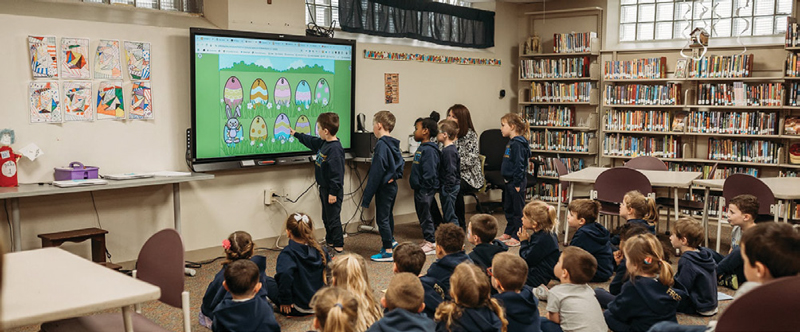
Advanced learners take honors mathematics in grades four through eight. For 2025–26, St. Luke is piloting an honors English language arts program in grade six, with plans to expand it the following year. A one-to-one device program using iPads and Chromebooks connects lessons to real-world applications, preparing students for their futures.
Student Formation Beyond Core Academics
In what ways do students grow through leadership, arts, service, and activities?
Students develop into confident learners and compassionate leaders through roles in school safety, daily announcements, Reading Olympics and civics, among other offerings. Sixty-five percent of seventh- and eighth-grade students participate in the National Junior Honor Society, leading food drives and community outreach.
-
We have an incredible number of second and third-generation families and even some fourth-generation families. Our families give so generously of their time and talents and that generosity is infectious; it trickles down to our new families and to our students.
Over 75% of eligible students participate in chorus, strings, band, liturgical choir, or the annual school musical. Many go on to perform in regional honor ensembles, including the Archdiocesan Festival, Honor Band Festival, Honor Chorus and Honor Strings. The music program has earned multiple awards at Music in the Parks, the jazz band was recently honored at a LaSalle College High School festival and graduates have received scholarships in vocal and instrumental performance.
The fifth- through eighth-grade robotics team has advanced to the FIRST LEGO League state championships for two consecutive years; the only team in the Archdiocese of Philadelphia to achieve that distinction.
A Model of Family and Parish Partnership
Why does family and parish partnership remain central to the school's model?
Family engagement drives the school’s success as much as any academic program. The Home and School Association is described as the strongest and hardest-working in recent memory and parents regularly attend Mass and prayer services alongside their children. The school believes that students who see their families volunteer will become volunteers themselves.
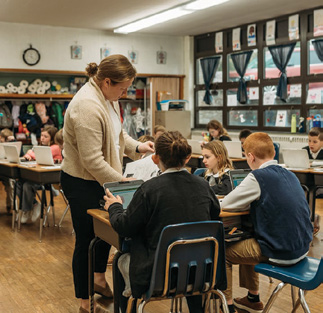 “In Catholic schools, the education of every student is a partnership between the family and the teachers,” says Lawlor. “I think St. Luke Catholic School is a model representation of how that partnership is supposed to operate.”
Parishioners watch students grow over the years and students see faith practiced collectively, strengthening what teachers build in the classroom.
Faculty Commitment and Institutional Stability
Over 50% of teachers hold advanced degrees, over 90% are Catholic school graduates and several are St. Luke alums. Father Joseph D. Brant, the school’s pastor, commends their commitment and expresses his gratitude for all they do. Their efforts have earned the school recognition as an Archdiocese of Philadelphia School of Distinction for five consecutive years.
Working with the Archdiocese on teacher retention and compensation, the school also plans to expand honors coursework and introduce Spanish.
For families seeking a Catholic education grounded in academic rigor and community, St. Luke Catholic School delivers a disciplined, enduring model. More than a century after its founding, the school shows that mission-driven education, academic progress and generational trust can thrive together—a distinction that firmly supports its recognition as Top Catholic Elementary School 2026.