

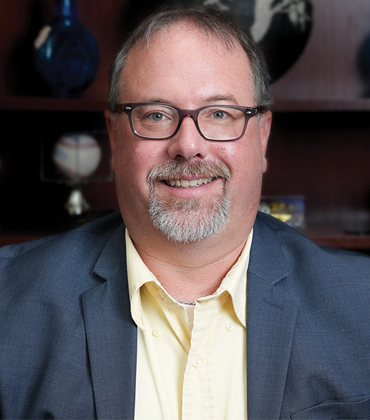
 Dr. Brenden Rickards, President
Many first-generation students entering higher education face unclear expectations and complex institutional jargon, which can hinder comprehension and slow their academic progress.
Rowan College of South Jersey (RCSJ) addresses this by making academic language more accessible. Majorly serving first-generation college attendees, it aligns communication directly to student needs, ensuring expectations, pathways and outcomes are clearly understood from the outset.
Students arrive at the college seeking training oriented toward their employment aspirations. RCSJ structures its academic model to bridge this intent, integrating traditional disciplines with career-focused pathways that support immediate and practical workforce entry.
“We believe in opening doors—making sure every individual has access to meaningful training and the support to pursue whatever path they choose,” says Dr. Brenden Rickards, president.
Career Opportunities across Disciplines
How does the institution offer diverse academic programs aligned with workforce requirements today?
RCSJ offers programs spanning multiple fields, including traditional sciences, health sciences and business, with hands-on programs in manufacturing, trades and engineering. Academic disciplines also include behavioral sciences, criminal justice and humanities.
In healthcare, RCSJ has developed a strong portfolio of programs from frontline patient care to critical backend functions. Its terminal degree programs enable students to complete an associate degree and enter the professional sphere in two years. A robust nursing program anchors this offering, supported by specialized pathways in physical therapist assistance, radiography, diagnostic medical sonography and nuclear medicine technology.
Its premier partnership with Inspira Health, a nonprofit regional health system, guides the development of new programs. RCSJ’s collaboration with its primary partner, Rowan University, enables four-year pathways in fields like medicine and respiratory therapy.
-
We believe in opening doors—making sure every individual has access to meaningful training and the support to pursue whatever path they choose.
In addition, RCSJ’s traditional engineering and engineering technology offerings pair design with practical work. In STEM, a unique veterinary technology program equips students for technical roles in animal healthcare.
Expanding into the field of photonics, RCSJ focuses on applied work in lasers and optics, developing its program with the National Science Foundation in collaboration with Rowan University and Princeton University, supporting workforce needs in advanced technology sectors.
Courses in behavioral sciences and law and justice include pathways to social work, psychology and drug and alcohol counseling.
Business offerings, including finance and ultra-entrepreneurship, are developed through collaboration with Rastelli Foods Group to align curriculum with industry needs. Additional support from Acenda Integrated Health, a nonprofit behavioral health and social services organization, and First Harvest Credit Union, a federally insured, not-for-profit financial cooperative, extends its skill development efforts.
RCSJ’s ability to guide students into these diverse career paths comes through a faculty and staff committed to student success, enabling close collaboration with industry partners to ensure students gain the required skills.
A Cost-Effective Route to Higher Education
Why does the 3+1 model provide a cost-effective pathway to bachelor’s degrees?
RCSJ’s unique 3+1 model, developed with Rowan University, provides high-quality pathways to bachelor’s degrees. The program allows them to complete three years at the college, before continuing at the university to complete the final year.
Students gain a cost advantage by paying four-year tuition for only one year while completing the same university curriculum, ensuring a seamless route to a bachelor’s degree.
In what ways does the college support career changes and workforce entry through programs?
In one case, a non-traditional student entered after time in the workforce, beginning at the lowest level of mathematics. He progressed through the curriculum, earned an associate degree in engineering, transferred to the University of Michigan and completed his engineering degree before entering the workforce again. His journey reflects how the college supports students pursuing career change or direction through structured guidance from the ground up.
RCSJ is advancing its industry-driven program growth, expanding into fields like medical technologists and surgical technologists. It is also addressing regional shortages in manufacturing and trades by creating pathways for students unable to access technical high schools, as well as for career changers seeking entry into skilled labor roles. These initiatives are developed in collaboration with industry and government partners to support direct workforce entry.
Through its focus on applied training and industry alignment, RCSJ connects all students to defined, achievable career pathways.