


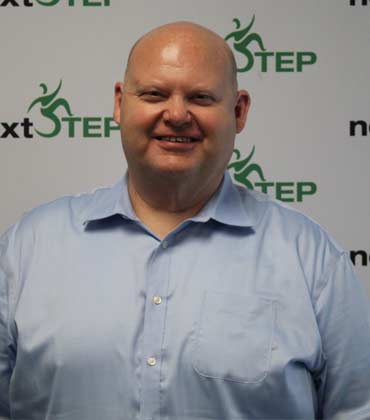
 Barclay Spady, Principal
There is no judgment and no demand for an explanation. Staff members help each student identify the next achievable step based on their circumstances, readiness and goals. Next Step begins with the belief that no two students require the same educational pathway, making personalization a starting point rather than an accommodation.
Students are more likely to re-engage when they feel supported rather than evaluated. Once that connection is established, teachers rebuild academic confidence through manageable goals. A student overwhelmed by an entire course may begin with one assignment. Completing it creates an early win, making the next step feel possible.
“Small steps are still progress,” says Spady.
Next Step carries that belief into each student’s program. Rather than requiring every learner to follow fixed attendance patterns, a common pace and a standard course sequence, the school builds around the student’s starting point. A younger learner may need a gradual transition into high school, while an older student with limited credits may require an accelerated route toward completion. Courses can be paused, rearranged or added as circumstances change.
Relationships Before Instruction
Students attend one of Next Step’s three campuses at least once a week, where they meet teachers to review progress and agree on what comes next. Next Step treats connection as a condition for learning, not an addition to it. Even strong instruction has a limited impact when a student does not trust the person providing it.
Regular contact prevents independence from becoming isolation. Success coaches provide social-emotional support, contact families and, when necessary, meet students at home or in the community before helping them return to campus. Teachers also make weekly positive calls to families. Instead of contacting home only when something goes wrong, they recognize completed work, improved attendance or another meaningful step forward. Those interactions rebuild trust, strengthen engagement and encourage students to take ownership of their learning.
Connecting Progress with Future Plans
Career planning develops through the same individualized process. As students regain confidence and begin taking ownership of their education, conversations move from completing the next course to considering what follows graduation.
-
Next Step treats connection as a condition for learning, not an addition to it. Even strong instruction has a limited impact when a student does not trust the person providing it.
Project-based courses introduce practical problem-solving and hands-on learning, opening pathways into trades and technical careers. Teachers and success coaches connect course choices with postsecondary requirements through discussions and tools such as My Blueprint.
Digital access extends that individualized model beyond campus. Through Brightspace, Google Classroom, virtual labs and online textbooks, students can work when they are ready while using formative assessments to determine whether they understand the material or need teacher support. Formal assessments remain in person to protect academic integrity.
Growing Without Losing Connection
Next Step expects enrollment to exceed 850 students, compared with approximately 200 four years ago. Provincial data shows satisfaction with educational quality at 97.2 percent, compared with Alberta’s 87.8 percent average. Its welcoming, caring and safe learning environment received 95.9 percent, compared with the provincial average of 85.8 percent.
Growth creates a new responsibility to expand without losing the relationships that define the student experience. Spady views the results not as a ceiling, but as a standard the school must continue to improve upon.
Next Step’s results show what can happen when flexibility is reinforced by consistent human support. By establishing belonging first, the school builds the trust that can help students re-engage, take ownership of their learning and continue toward graduation. That combination of individualized pathways, accountability and measurable educational quality has earned Next Step recognition as a Top Senior High School in Canada 2026.