


Montessori isn’t a short-term program. It is a method built on consistency, trained educators, and long-term classroom rhythm. A true Montessori environment depends on stable classrooms and well-prepared guides who can carry the method forward year after year. In Southern Nevada, sustaining that continuity took extra work, both in maintaining consistent practice and in ensuring teachers had access to proper Montessori preparation. With no local pathway for Montessori certification, educators had to travel out of state to train.
Montessori Visions Academy emerged to address these needs. Established in 1999, it became one of the longest continuously operating Montessori school serving families in the Las Vegas and Henderson communities, built around a long-term commitment to authentic practice. Today, the academy serves students from birth through 12th grade and maintains accreditation with the American Montessori Society (AMS) and Cognia, reflecting its commitment to recognized educational standards while preserving Montessori integrity.
“Montessori education demanded more than classrooms alone. Supporting students and teachers meant creating the structure needed to sustain the method locally,” says Lori Jo Bossy, head of school.
Sustaining Montessori Through Prepared Educators
How did the academy create a local teacher preparation pipeline?
 Growth brought a long-term decision. Rather than rely on out-of-state certification to staff classrooms, Montessori Visions Academy chose to build a local pipeline for prepared Montessori guides. In 2004, the academy launched Montessori Training of Southern Nevada, a teacher training program accredited by AMS and the Montessori Accreditation Council for Teacher Education (MACTE). Establishing a local pathway for teacher preparation extended the school’s responsibility to the educators entrusted with sustaining authentic Montessori practice. In doing so, it strengthened classroom consistency and protected the integrity of the method year after year.
That decision reshaped what the school could sustain day to day. Inside the classrooms, Montessori Visions Academy reflects the principles it was founded to protect. Students begin with hands-on materials, revisiting lessons through movement, repetition, and observation until understanding develops through sustained practice. That foundation shapes how instruction unfolds. Lessons are introduced individually, guided by readiness and interest, and students move through a sequential curriculum at their own pace. Teachers observe closely, offering direction and support while allowing students to take increasing responsibility for their work. Over time, the structure helps students build confidence in both what they learn and how they learn.
The same emphasis on purposeful, student-driven learning shapes how technology is introduced. STEAM education is integrated into daily classroom practice across all levels, including early childhood. Science, technology, engineering, art, and math are approached as connected areas of study rather than isolated subjects. Students use computers for research and exploration in support of their work, developing comfort with technology while remaining grounded in concrete learning experiences. Expectations around thinking and expression are clear. Students are expected to create their own ideas and complete their own writing, and AI is not permitted to produce student work. Teachers reinforce that technology is a tool to support learning, not a substitute for independent thinking or creativity.
Allowing Different Learners to Thrive Together
How does the multi-age structure support individualized progress?
Montessori Visions Academy is organized around a classroom structure that accommodates differences without drawing attention to them. Students learn in multi-age environments that operate on three-year cycles, allowing children to remain with the same teachers and peers over time. This continuity enables teachers to understand each student’s learning style, pace, and individual needs in depth, shaping instruction through sustained observation rather than short-term assessment.
Since learning is individualized, students progress through the curriculum at their own pace. Progress is not measured against classmates, and there is no fixed expectation that everyone should arrive at the same outcome. This structure supports students with varying learning needs, including neurodivergent learners, who benefit from consistency, hands-on materials, and the absence of comparison.
-
Montessori education demanded more than classrooms alone. Supporting students and teachers meant creating the structure needed to sustain the method locally.
Responsibility develops within the environment through participation. Students take ownership of their work using individual planners and are involved in organizing their lessons and tracking progress. Classrooms also hold community meetings where students help shape shared guidelines for how they learn and work together. Teachers remain closely engaged, guiding and supporting each child as they gradually increase responsibility. Within the multi-age setting, peer support and peer tutoring become part of daily life, with older students modelling skills and younger students learning through observation and collaboration.
Prepared Guides and Lasting Relationships
How do long-term teacher relationships strengthen student development?
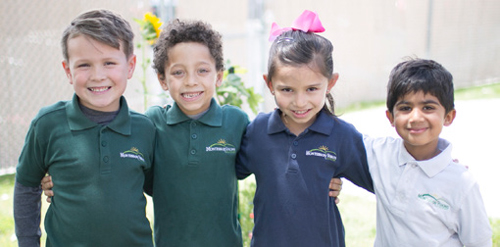 The academy’s investment in teacher preparation shaped the school's culture. Teachers at Montessori Visions Academy choose Montessori intentionally as their professional path. Some educators have been with the school since it opened more than twenty-five years ago, while new teachers join a community shaped by shared values and long-term commitment. This stability allows relationships between teachers, students, and families to develop over time, creating trust and familiarity that support learning and growth. Those relationships are strengthened through shared activities, community events, and ongoing dialogue, building connections that extend beyond the classroom.
The long-term connection also shapes how students are supported as they grow. Programs like the Heroic Journey provide mentorship and guidance to adolescents, helping students through key developmental stages and reinforcing educators' role as long-term guides. At the same time, instructors’ relationships with parents and caregivers provide them with insight into cultural backgrounds and learning contexts. That understanding informs instruction and helps ensure students feel represented and supported as individuals within the classroom community.
“We wanted to support our teachers, students, and community with knowledgeable, trained, certified Montessori teachers so we could offer the best environment for the students,” says Bossy.
Community Beyond the Classroom
The academy’s approach to community extends beyond its classrooms. Service learning connects academic learning with real-world responsibility through projects that support the broader Las Vegas and Henderson communities.
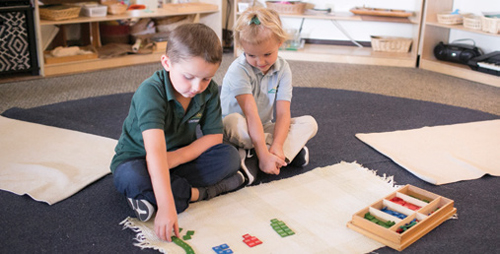 In elementary classrooms, students partner through a buddy system that pairs older and younger students. One recent project involved an elementary and primary classroom preparing more than 200 sack lunches for an organization serving people in need in Las Vegas.
For middle school and high school students, community outreach expands through structured service weeks focused on local projects. Upper elementary students also participate in scheduled service initiatives during the academic year, reinforcing the idea that responsibility grows alongside independence.
Early childhood students are included as well. In the classroom, service is tied to academic units, like collecting and counting donations while learning about money. These experiences help children understand contribution and responsibility in concrete ways.
These reflect the kind of culture the academy has worked to sustain over time. Montessori Visions Academy has never treated Montessori as a trend to adopt. Instead, it approaches the method as a responsibility to protect and maintain. That commitment is reflected in prepared educators, classrooms designed for independence, and a culture that practices responsibility daily. After more than two decades, the academy continues to focus on building the conditions that allow students to think independently, contribute meaningfully, and grow within a stable learning environment.