


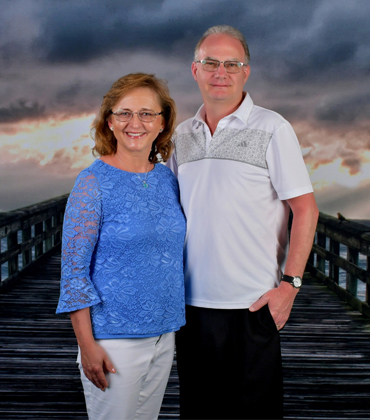
 Dr. Danuta Case, President and Provost and Rev. Tim Case, Master of Theology
In 2022, one of those students arrived with no plan for college at all. She had barely graduated high school, intended to stay one year to learn scripture more deeply and was already a wife, a mother and a grandmother. The first stretch was difficult. She struggled in her courses and often felt overwhelmed. She stayed because professors offered grace and practical help and fellow students worked along with her. That support kept her in the classroom when leaving would have been easiest. She graduated with a bachelor’s degree, a renewed sense of purpose and a ministry serving children most people had already written off.
“I discovered that God has a destiny for me, and He believed in me and He has so much more for me than I ever thought would be possible,” she said at the Senior Brunch during commencement.
Her story reflects the kind of graduate Elim Bible College seeks to develop. Elim has trained students for ministry and Christian service since its founding. It became accredited in 2015, and currently the college offers bachelor’s in theology and business, associate in biblical studies and business administration, and certificate programs, each built on the same foundation of academic excellence, spiritual formation, and practical preparation.
“It begins with a hunger for God and a desire to know Him more deeply. That hunger is nurtured by our faculty and staff, and through the student’s commitment and perseverance, it leads to a transformed life and a degree,” says Dr. Danuta Case, President of Elim Bible College.
A Calling before a Plan
Some students arrive with a clear call to ministry and step directly into a four year theology program. Most do not. They come carrying a sense that God wants something from their lives without yet knowing what that something is. A college built only around coursework would leave that feeling unresolved. Elim built spiritual formation into its structure so that the question has somewhere to go.
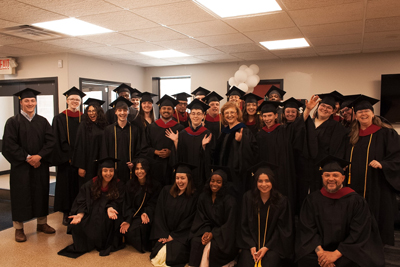 “One of the most important aspects of somebody who is graduating from high school is to strengthen their foundation in God, to really come to understand not only what they believe, but why they believe it,” says Dr. Case.
Chapel is held three times a week. Every degree includes a required block of student ministry work: six semesters for a bachelor’s, four for an associate and two for a certificate. Academic study tests what students believe against Scripture rather than handing them conclusions. The effect is measurable. Most students arrive planning to stay for one year. Because that first year answers the question they came with, more than half stay to complete a degree they never intended to pursue.
The People Behind the Calling
The answer students find rarely comes from a syllabus. It comes from a person. That is why Elim built its model around a scale small enough to enable personal formation.
A college the size of a lecture hall cannot know each student well enough to notice when someone quietly stops showing up. Elim is small enough that disappearing is difficult. Two numbers show what that scale looks like in practice:
• A 14:1 student-to-faculty ratio
• An average class size of 13
Those are the mechanisms that make the rest of the model work.
-
One of the most important aspects of somebody who is graduating from high school is to strengthen their foundation in God, to really come to understand what they believe and not only what they believe, but why they believe it.
Mentoring depends on the same scale. Faculty, staff, and campus volunteers meet with students one-on-one, but availability alone does not create mentorship. Time does. Elim creates that time deliberately, including complimentary lunches for faculty and staff designed specifically to give conversations a place to happen. The support structure runs on a clear chain of responsibility:
• A full-time Dean of Students and an Associate Dean of Students, who also leads ministry, oversee the network
• Resident advisors, drawn from the junior and senior classes, each lead a cadre of no more than ten students
• Each RA meets with their cadre regularly, catching a problem at that level before it becomes a crisis that the dean’s office has to handle
The result is an 88 percent retention rate. Students who planned to stay one year often stay longer because they have formed relationships that matter. Remove the relationship and the year would simply end as planned.
The model requires participation. “Support is a two-way street. In my experience, students who feel unsupported are often those who haven’t reached out. The mentors are there, but you have to walk through the door. No one is meant to be a standalone island,” says Dr. Case.
Clearing the Path to a Degree
Elim’s three-year diplomas once transferred easily into bachelor’s programs at Christian universities. As accreditation standards tightened, one of Elim’s strongest transfer partners, Regent University, eventually closed that pathway. By the time Dr. Case joined Elim in 2013, a student with 96 earned credits could transfer only nine of them. The remaining 87 credits, three years of work, no longer counted.
Accreditation also affected affordability. Many Elim students come from families with limited means and qualify for federal and state financial aid, but a school without accreditation cannot unlock that aid. Before 2012, Elim operated as a nonprofit ministry rather than a state recognized degree granting institution. That year, it secured authorization from the New York State Department of Education, a prerequisite for pursuing accreditation. Dr. Case was hired in 2013 to complete that process and accreditation status was granted in 2015. The impact was structural. Credits began to transfer again, and financial aid became available to students who had long qualified for it.
Keeping the Calling Affordable
Access without affordability is not access. Elim caps out of pocket costs for full time residential students at $13,900 a year, regardless of program and every full time student receives some form of aid. The policy reflects the reality of where most graduates serve—ministry, missions and nonprofit work—fields where salaries cannot absorb heavy debt.
The same logic guided Elim’s recent pathway for students transferring from Alliance University, formerly Nyack College. A one time scholarship helps them complete degrees that might otherwise have gone unfinished due to the school’s closure.
Carrying the Model beyond Campus
In 2022, Elim launched full degree programs through distance education, removing a barrier that had excluded entire groups of students.
Reach without relationship would have undermined the model, so Elim built its online structure to prevent that. Faculty teaching online courses remain visibly present, leading discussions, responding quickly to messages and meeting students by video. Many go further, calling students to pray with them through difficult weeks. Deans hold office hours specifically for distance learners. Chapel streams live, so a student in another state can still participate. Distance students complete roughly five hours of weekly ministry at a local church, mirroring the practical formation required on campus. The location changes; the formation does not.
A Measure that hasn’t Changed
A hundred years in—and newly named Bible College of the Year—Elim still measures itself not by how many are enrolled, what was built, but by what a student believes when they leave and whether they can explain why. Accreditation made the degree reachable. Affordability made it sustainable. Mentorship and spiritual formation made it transformative. Distance education made it possible without a move.
Together, those elements produced a graduate who arrived with no plan and no confidence she belonged in a classroom and who now spends her life handing that same discovery to children others had already given up on.