


It’s the question teachers ask and are expected to fulfill every day.
 However, loudness does not guarantee a clear voice. Words may be audible without being easily understood or even intelligible. In classrooms, the gap between hearing and comprehending can be the difference between students keeping pace with a lesson or falling behind. A direct contradiction to the outcome desired.
“The difference lies in distortion,” explains Jim Goetz, CEO of Cetacea Sound.
“Distortion is more insidious than everyday classroom noise like chairs scraping and shoes tapping on the floor, which may be a distraction but is somewhat manageable. Room distortion happens when amplified sound bounces off the floor, ceiling, walls and windows arriving at the student’s ears as reverberation and echo, which reduce comprehension. Even worse is the fact that every room is different.”
We’ve never viewed the classroom speaker as just another audio device. It is the anchor of the learning environment. As technology evolves, its role will expand to make teaching easier, communication clearer and student engagement stronger.
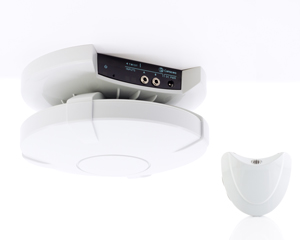
 The Cetacea Sound solution has become popular because it is specifically designed for the classroom, aiming to minimize the effects of classroom distortion on intelligibility. Its classroom audio system, a “SOUND FIELD,” pairs the ASTRONAUT speaker with ORBITER microphones, producing high clarity intelligible speech across the classrooms and helping reduce inherent distortion. The patented speaker’s shape and custom-designed transducer distribute low-distortion sound evenly so that every student hears the same sound as the others.
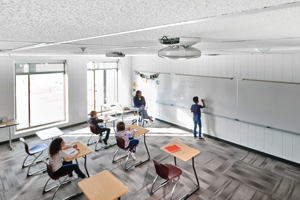
The room becomes the “sweet spot” rather than just a few privileged seats. By placing the speaker overhead, clear, intelligible speech reaches the students’ ears before inherent room distortion, which improves comprehension caused by echoes and reverberation. For schools that have not upgraded their classrooms with architectural acoustic treatments, this is a game-changer.
Voice clarity in the classroom increases meaningful engagement with students. Lower distortion raises student attention and understanding. Administrators note that the increased engagement leads to calmer and more focused students, a shift they attribute to students’ improved ability to comprehend spoken instructions and lessons.
Most striking were the reactions of some children who relied on assisted listening devices. For the first time, they were able to participate equally with their classmates without physical hearing aids; an independence that one director described as “transformational.”
 “Our goal is not just audibility but equity. Clarity should not depend on where a child sits. It should be universal, and that’s what we are here to offer,” says RJ Goetz, Director of Sales and Marketing.
Presenting the Teacher’s Voice, True and Clear to Each Student
Preserving the fidelity and intelligibility of the teacher’s voice by presenting it to the student’s ears before it becomes distorted is the objective. The system accomplishes its objective in part by focusing on the band and frequencies roughly in the 300 Hz to 15 kHz range, which are critical for speech intelligibility. Within this range, vowels give speech its nuances and innuendo while the sharper consonants—“s,” “t,” “f,” and “k”—deliver the detail that makes words intelligible in all languages.
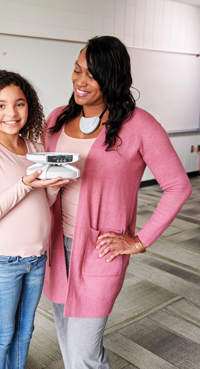
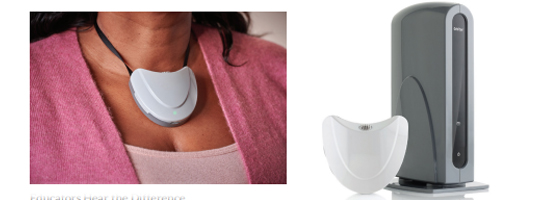
To ensure the details are not lost, Cetacea Sound’s Sound-Field starts at the source. The wireless ORBITER pendantstyle microphone rests comfortably around the teacher’s neck, capturing tone and volume at a consistent level. Unlike desktop or handheld mics, which can cause volume to fluctuate, the pendant volume remains stable regardless of where or how the teacher moves. And, it is a hands-free teaching experience. The teacher can walk around the room, write on the board, and interact with study groups while still delivering the same volume and clarity to every student.
-
Our goal is not just audibility but equity. Clarity should not depend on where a child sits. It should be universal, and that’s what we are here to offer.
Capturing the voice is only half the equation. Keeping it steady and clear is the other. Ordinary wireless microphones can struggle in busy classroom environments, leading to dropouts or interference when multiple systems operate nearby. The ORBITER’s proprietary wireless link uses a high-speed microprocessor to create a dedicated, interference-free connection with CD-quality audio and ultra-low latency. Its intelligent design allows multiple microphones to operate seamlessly across classrooms and even district-wide—without the need to manage channels or worry about cross-talk. The system also adapts to collaborative learning, allowing two microphones to pair to the same speaker so team teaching feels natural, with both voices carried at equal clarity. The second mic can even be passed among students, giving them the same vocal presence as their instructor.
The ASTRONAUT speaker completes the objective with a multi-patented solution. Designed to fit on the ceiling, its omni-directional sound path helps deliver voice frequencies to the students’ ears before they are disturbed by the room distortion.
 Educators Hear the Difference
After installation, the difference is heard immediately. Foreign language teachers are often the first to notice. They hear how precisely the system carries the delicate details of pronunciation, intonation, and nuances that, until then, were lost in their poor classroom acoustics.
“The audio quality is so high that my classroom feels calmer and more focused,” one educator said. “Even students who used to get restless settle down once they can understand speech better and follow along. Clear, low-distortion audio changes the classroom dynamic the moment it is switched on.”
Comments like this capture more than a passing impression. They underscore what schools have been missing for decades.
Decades of Research
The company’s technology is reinforced by decades of research. The landmark Mainstream Amplification Resource Room Study (MARRS), first conducted in the late 1970s, proved that intelligible amplification in classrooms improves reading, language development and overall achievement not only for students with hearing challenges but for entire groups. Cetacea Sound carries those research-backed principles into practice with its technology, delivering on the promise that MARRS outlined nearly half a century ago.
Energy Efficiency
Although the ASTRONAUT power supplies already meet Circle VI California efficiency standards, even higher energy efficiency is on the agenda. Engineers will continue to improve efficiency to align with the sustainability goals that schools and districts are setting for the coming years.
Designed, Engineered and Manufactured in the USA
Cetacea Sound designs, engineers, and manufactures its products in Plymouth, Minnesota and has been in business since 1996. Its customer base consists of public and private schools, K-12, colleges, universities, corporations, and many government agencies, including the military.
Innovation for Tomorrow
The next phase of classroom audio is already being shaped by Cetacea Sound. The company’s next generation SOUNDFIELD systems are being designed to offer greater flexibility, effortless setup, and seamless integration with a wide range of learning technologies. Cetacea Sound’s strength lies in blending innovative new features with its proven lifetime audio technology—delivering solutions purpose-built for the dynamic environments of classrooms and training rooms.
 At the heart of every new system remains the patented speaker design that produces the low-distortion, omnidirectional sound field educators have come to trust. Around that core, new layers of intelligent technology will continue to evolve—enhancing connectivity, adaptability, and performance for the classrooms of tomorrow.
Flexibility for teachers is central to this vision. Building on the success of the Orbiter Pendant Microphone, Cetacea Sound is exploring ways to expand its line of microphone options, giving educators more freedom to move, collaborate, and engage students—all while maintaining clear, natural-sounding voice amplification.
“We’ve never viewed the classroom speaker as just another audio device. It is the anchor of the learning environment. As technology evolves, its role will expand to make teaching easier, communication clearer and student engagement stronger,” says Goetz.
When every student experiences an equal opportunity to hear and understand the teacher, regardless of seating, the classroom becomes more than a place to deliver information; it becomes a space where learning feels effortless, engagement is improved, and the learning environment is calm and efficient.
That is the future Cetacea Sound is working toward.