

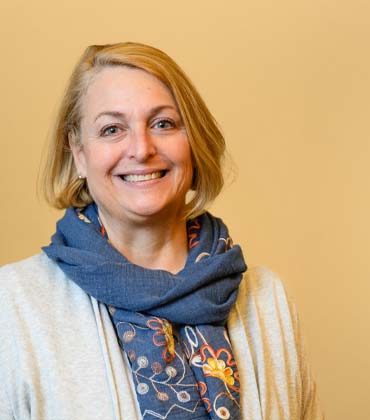
 Mary Beth Ricks, Head of School
In one of the youngest classrooms at Bowman School, a year-round Montessori school in Palo Alto, CA, a child is learning about the rainforest—what grows and lives there, plus how that ecosystem fits together.
In another building, an upper-elementary student is asking why some species thrive in the same environment while others do not. Down the hall, a middle schooler is studying what happens when that balance is disrupted by pollution. Across campus, a high school student is working through a more personal question: What can I do with this knowledge to make a difference in the world?
The rainforest topic is the same. The depth changes as students move through the grades.
A continuum like this requires more than a well-sequenced curriculum. It depends on a school structure that protects the child’s full learning environment.
Mary Beth Ricks, head of school, believes children do best when school works for families and when teachers are well-supported to do their best work.
“Whenever I make decisions, I’m always thinking, is this what’s best for the children?” says Ricks. “Our entire school is very student-centric. Yet Bowman also considers our parents’ needs, to deliver work-life balance to families. Additionally, we take good care of our staff because our students will be better off when our teachers are well-trained and cared for.”
 Each part reinforces the other, allowing children to move through school with continuity, curiosity and a stronger sense of purpose.
How does interdisciplinary curriculum design deepen understanding as students revisit concepts over time?
A Spiral Staircase, not a Straight Line
Conventional schools are linear. They cover a concept and move on. “In our school, it is more like a spiral staircase,” says Ricks.
Whenever I make decisions, I’m always thinking, is this what’s best for the children?
 Encountering core concepts at the K through 3 level, Bowman students return to them in upper elementary, again in middle school and once more in high school. Each pass deepens comprehension. A child who first learns what a rainforest is eventually examines the political and economic forces that threaten it.
Teachers bring global study back to local life. A lesson on another culture asks not only what happens elsewhere, but what connects to Palo Alto and Silicon Valley. This trains students to notice links between broader history and their everyday experience.
Where Flexibility Meets Structure
Bowman honors each student’s pace, interests and strengths, but does not let them drift away. There is a clear curriculum plan across the school. Teachers work within a rigorous academic framework. Expectations are high.
“We have very demanding academics,” says Ricks. “With that rigor comes the recognition that every child has strengths and gaps in learning. We watch for both.”
Multi-age classrooms, each spanning three years, give teachers room to respond to those differences. Topics stay consistent within an age group. How each child engages with them will vary.
“The delivery of the learning product is individualized so that we appropriately cater to the children’s strengths while also supporting their gaps,” says Ricks. Bowman’s low teacher-to-student ratio means teachers know where every student is and what comes next.
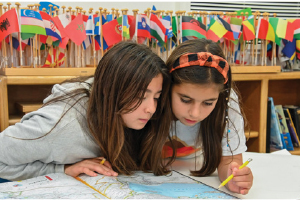 Mixed-age groupings do something else. A three-year span means every child cycles through being the newcomer, the steady middle or the experienced voice in the room. That rotation naturally builds social confidence and responsibility. Older students help younger ones navigate routines and settle in. Support becomes part of the classroom culture, rather than something that singles anyone out. And because the age range is wide, a student working above or below a typical grade-level marker does not stand out as much as they might in a single-grade room. Teachers can stretch material forward and reinforce foundations without drawing attention to either.
Why are hands-on materials and community participation central to Montessori educational development models?
From Beads to Abstraction
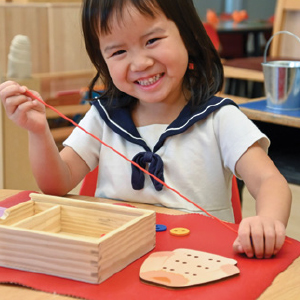
Bowman’s rigor is grounded in Montessori materials that move students from hands-on experience to abstract thinking. That progression is especially visible in math. Younger children work with beads, blocks, puzzles and boards that make concepts tactile and concrete. Over time, they become mental frameworks.
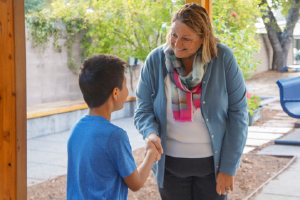 Teachers watch the transition happen. A child who once needed every bead to count through a multiplication pattern begins to internalize structure and skip steps. First, they hold a place with fingers, then with eyes, then without the material at all. That is how Bowman knows concrete mastery is taking hold. Teachers do not remove support too early. They look for evidence that a child can explain a concept, use it independently and transfer it into new work. In Bowman’s secondary program for 6th–12th graders, that progression continues through the International Baccalaureate framework, which extends the same emphasis on inquiry and critical thinking into high school academics.
Citizenship as Practice
Global citizenship at Bowman is not a curriculum label; it is a daily practice. Younger students take ownership of their classroom by performing jobs like watering plants, sharpening pencils or restoring order at day’s end. Those routines teach that community depends on care, not just participation. Children learn to solve problems diplomatically, speak clearly about conflict and stay aware of needs around them.
-
Intelligence without kindness is incomplete. Collaborative environments depend on both competence and consideration. We treat those as connected truths.
“Intelligence without kindness is incomplete. Collaborative environments depend on both competence and consideration. We treat those as connected truths,” adds Ricks.
Cultural diversity strengthens that sense of community. Bowman is not a religious school, but actively makes room for families to share traditions, celebrations, foods and customs from widely ranging backgrounds. With dozens of nations represented across staff and families, diversity is a lived reality. Presentations around Ramadan, Diwali, Persian New Year and Lunar New Year help students understand differences through food, dress, storytelling and family practice. Children gain regular exposure to perspectives beyond their own while learning that many kinds of families belong in one school.
To what extent do flexible school structures support families, teachers, and student continuity effectively?
Four Campuses, One Bowman
Bowman operates across four campuses in Palo Alto. Leadership works hard to keep these functioning as one. The internal motto is simple—four campuses, one Bowman.
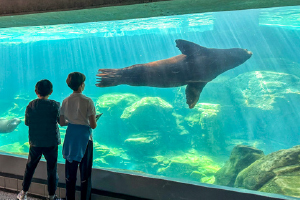 This requires effective systems. Staff meetings, shared onboarding, teacher exchange and cross-campus student activity reinforce a common culture. Older students move between campuses for classes and buddy programs.
“Bowman Plus One” makes that structure visible. Every staff member has a core role and one added responsibility within a cross-school team. Those teams handle hospitality, operations, student support and campus experience. They bring together people from different grade levels, departments and sites, including office staff. The design builds ownership and communication across levels. Preschool staff, high school teachers and administrators learn to think as one.
A Founding Idea that Still Holds
Most school calendars still follow a rhythm based on summer harvesting priorities from the early 1900s. For modern working families, this no longer aligns well with daily needs. Bowman improved this fundamental design point with a better-fitting school schedule.
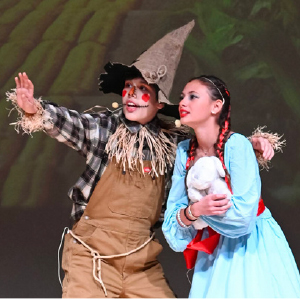 Now, a favorite feature for Bowman families is the flexibility and continuity of learning that is uniquely available here. Bowman provides extended hours daily and supports a year-round calendar, allowing families to choose their own time off (which is possible with carefully tracked, individualized learning).
Bowman’s schedule has proven to be durable and popular. This Montessori school strives to support family stability, teacher effectiveness and student growth. Education Insider has named Bowman its Montessori School of the Year for 2026 in large part because of its consistent focus on maintaining this balance. Formats, programs and campuses have evolved over three decades, while Bowman’s core values provide a solid foundation for shaping lifelong learners and critical thinkers who can thrive anywhere.